Monday, April 25, 2016

Life At Sixth Crossing

Hiking the Seminoe Cutoff Trail
The Sweetwater River
As noted in the previous post, the winters in Wyoming can be brutal.  The winter of 1856-1857 was the worst winter on record, as the Willie and Martin Handcart Companies made their way to the Great Salt Lake Valley.  It is not unusual for winter storms to blow through this area every five to seven days.  We have been here at the Sixth Crossing of the Mormon Handcart Historic Site for eleven days.  During that time we have seen two storms come through, dropping 1-2 inches of snow, closing roads and disrupting power.  In between these storms the weather becomes quite pleasant, with temperatures reaching the lower sixty degrees, melting off any accumulated snow. 


The wind often blows here with the prevailing winds coming from the west-southwest.  Wyoming is ranked first in the United States with an average annual wind speed of 12.9 mph.  


Building and Painting Benches
When the days are nasty we spend our days indoors learning about the area and the pioneers who emigrated through here on their way to California, Oregon and Utah.  In between the wintery storms we head outdoors to work on projects such as cleaning up campsites, trimming willows, spreading native grass seed, painting picnic tables and benches, as well as familiarizing ourselves with the trails.  This may sound unusual for missionaries, but because winter can be so cruel here in Wyoming, the weather takes its toll on outdoor facilities. Plus, we want to ensure that visitors who come to Sixth Crossing have an enjoyable, pleasant experience and we can answer their questions.  

The Painting Crew

Loading Willow Cuttings
Currently we are in the off season, but expect to have trek groups arriving early June.  It is estimated that hundred and thousands of people will come this summer to enjoy the historic site and to hike the trails, and we want to be ready for them. So until then, we will continue working on stories and projects and hiking the surrounding trails.  I must admit, these past few days have been very fulfilling for us.  We have enjoyed getting to know the other missionaries we are working with. The surrounding scenery is absolutely beautiful with its wide open space and far off mountains.  Plus, there is a special spirit here, just to be able to walk where so many early pioneers walked before us.  We are coming to love Wyoming and its people.


Moon-rise over the Sagebrush
Remember: "You can't buy happiness, but you can live in Wyoming"
Elder and Sister Bowden

Sunday, April 17, 2016

Some Must Push and Some Must Pull

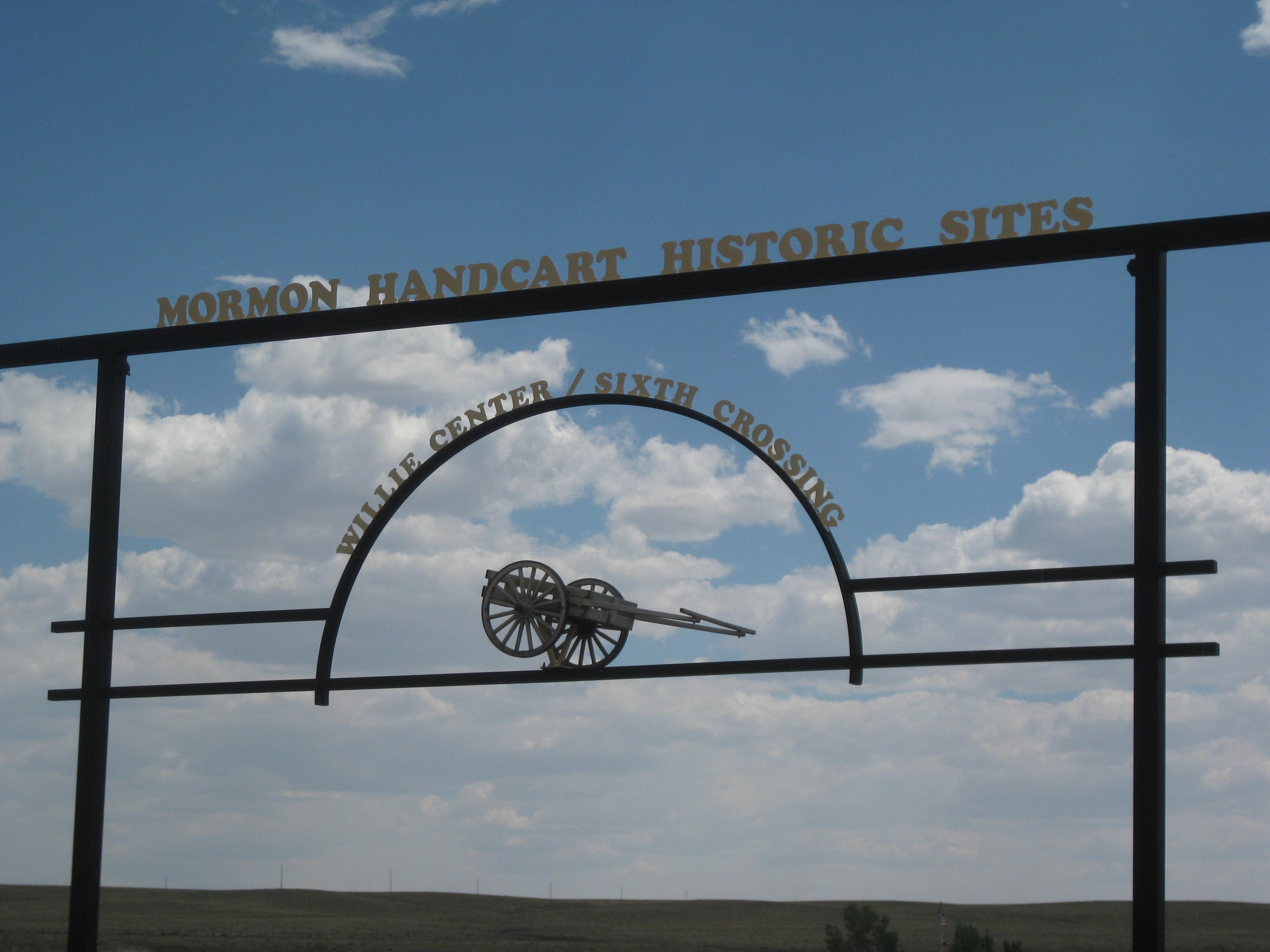
Mormon Handcart Historic Sites
Sixth Crossing
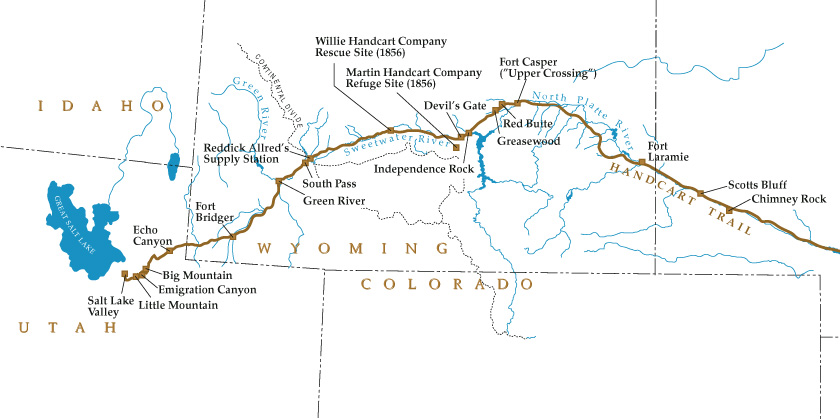
We left the Missionary Training Center in Provo, Utah on April 13, 2016 and drove to our assigned area at Sixth Crossing, Wyoming.  Sixth Crossing is not easy to find as it is not on the map, but is located on US Highway 287 about 40 miles east of Lander, Wyoming.  Here, on the Sweetwater River more than 500,000 people migrating westward between 1843 and 1869 stopped to rest and recuperate before crossing over the Rocky Mountains.  Some of these emigrants came in search of land, some in search of gold and some search of business opportunities, while others came for religious freedom.   Most of them settled in California, Oregon, and Utah.


Handcart Replica

Of these 500,000 emigrants, between 60,000 – 70,000 were members of The Church of Jesus Christ of Latter-day Saints, also known as Mormons.  After being driven from Ohio, Missouri and Illinois, they were seeking refuge from religious persecution – and a place where they could build Zion.  Brigham Young led the first group of Latter-day Saint pioneers through this area in 1847, on their way to establishing a settlement in the Salt Lake Valley. Most of the subsequent Mormon emigrants traveled in wagon companies but some traveled by handcarts.


Mormon Handcart Trail
In the mid-1850s Brigham Young, the President of the Church, faced a dilemma: thousands of converts from Europe were eager to emigrate, but most of them didn’t have sufficient funds.  To make their emigration possible, he developed the "handcart plan".  According to this plan, church members would sail from Liverpool to the eastern United States. From there, they would travel by train to the end of the railroad line in Iowa City.  From Iowa City they would walk the final 1,300 miles to the Salt Lake Valley, pulling their belongings in two-wheeled handcarts.  In contrast to the more than $200 required to outfit a wagon, a handcart could be built for $10 to $20.

Crossing The Sweetwater River
The handcart plan was implemented in 1856. Five handcart companies crossed the trail that year. The first three traveled quickly, without difficulties. The last two handcart companies, however, suffered a terrible tragedy. The Willie Handcart Company made it to the Fifth Crossing of the Sweetwater River on October 18, 1856, camped for the night, and prepared for the next day’s journey. The company was exhausted and out of food.   The next day they were hit by the season’s first major winter storm near Ice Springs, about 10 miles east of Sixth Crossing.  That evening, when they stopped at the Sixth Crossing they killed the last of their cattle.   George Cunningham wrote:  “. . . they were as poor as we were.   We boiled the bones and drank the soup.   We ate what little meat there was, we greedily devoured the hide".

James G. Willie
Captain Willie knew he must save his company, so on October 20th, with snow blowing in their faces, he and Joseph Elder rode out in search of the relief wagons that had been sent by Brigham Young from Salt Lake City.   They thought they would find them 10 – 12 miles west, but did not locate them for 27 miles.   The rescue party was also stranded because of the winds and snow. Early the next morning, they all started for the stranded handcart company. 

One of the rescuers, Daniel W. Jones, described the condition of the Willie camp when they located it with these words:  “On arriving we found them in a condition that would stir the feelings of the hardest heart. They were out of provisions and really freezing and starving to death.”  Six of the rescue wagons stayed with the Willie Company and eight others rolled eastward to find the Martin Handcart Company which was struggling under similar conditions.  The Willie Company continued on westward, eventually arriving in Salt Lake City November 9th.

Rescue of the Willie Handcart Company

Despite the heroic efforts of James Willie, other emigration leaders, and the rescuers, around 69 members of the Willie Handcart Company died along the way.   Many survivors suffered effects of the journey throughout their lives, but even those who suffered the most, rarely expressed bitterness or complaint.  Much more prevalent in their writings is their gratitude for the restored gospel, for the blessings of the sealing ordinances, and for a loving God. Betsy Smith of the Willie Handcart Company expressed these feelings:  “I will not dwell upon the hardships we endured, nor the hunger and cold, but I like to tell of the goodness of God unto us.”  

That is one of many legacies left to us by these handcart pioneers – the ability to see the goodness of God even in times of trial and adversity.  Their stories are of faith, obedience, sacrifice and charity.  It these stories we will be sharing with the visitors who come to walk the California, Oregon and Mormon trails of Wyoming.  Come with us, as we journey with these pioneer saints,

Elder and Sister Bowden

Handcarts Lined Up and Ready To Go

  (Note: material for this posting came from the Wyoming Mormon Trail Mission site manual)

Sunday, April 10, 2016

A Senior Moment

After leaving Florida and "Little Lara" we flew home to prepare for our next adventure -- 
a mission for the Church of Jesus Christ of Latter-Day Saints.  

Leaving for the MTC

On March 20, 2016 we were set apart as missionaries for the Church of Jesus Christ of Latter-Day Saints.  When we were set apart by our Stake President, he reminded us the Lord promised special blessings not only for senior missionary couples but also their families. Russell M. Nelson said, “When we think of missionaries, we generally picture in our minds young men with shirts and ties and young women dressed modestly. But along with them are marvelous senior missionaries who have answered the pleadings of prophets and apostles for more missionary couples." We too felt compelled to answer the Lord's call to serve.

Our room at the MTC

After visiting with family and friends we traveled to Provo, Utah where we entered the Missionary Training Center (MTC) on April 4th. Our MTC room is small and simple, with a queen size bed, two closets, a small private bathroom, and a desk. It’s fairly spartan in decoration, but we have not spent much time in our room.  At the MTC, senior missionary couples receive training in doctrine, conduct, and proselytizing methods. 

Our Name Tags
Plus, it was in the MTC we began using the titles of "Elder" (for the men) and "Sister" (for the women). These titles are reflected on our name tags. During our first week of training, we spent the majority of our time with other Elders and Sisters in class, with breaks for meals, temple attendance, fitness activities, and personal preparation time (for laundry, letter writing, etc).  


In our classroom
 with other Senior Missionaries

Full-time senior missionaries are called by the president of the Church of Jesus Christ of Latter-Day Saints. We serve voluntarily and at our own expense in a wide range of missions, including proselytizing, humanitarian, health, education, genealogical, as well as leadership missions. A missionary’s purpose is to “invite others to come unto Christ by helping them receive the restored gospel through faith in Jesus Christ and His Atonement, repentance, baptism, receiving the gift of the Holy Ghost, and enduring to the end”. 

Elder and Sister Bowden
standing with the first Church missionary,
 Samuel Smith
 For us, we spent our first week learning different teaching skills. This included an opportunity to practice those skills in the "Training Resource Center" where we learned how to teach by the Spirit. Here we went into a situation ready to teach one thing, only to discover we needed to teach something entirely different, as we tried to follow the Spirit's promptings. We also learn how to work with members, and church wards and branches. Next week we will travel to Salt Lake City Temple Square to receive specialized training on working in visitor centers, since we will be serving for six months in the Wyoming Mormon Trails Mission with a specific assignment at the at Sixth Crossing visitor center. 

While at the MTC  preparing to serve our mission we have met many wonderful senior and young missionaries.  They have come here from all over the world and will be leaving from here for assignments all over the world, including: the United States, Canada, England, Switzerland, Mexico, Dominica Republic, Brazil, China, Mongolia, Taiwan, and Japan.  

Standing before a world map
pointing to our assigned Mission
We have had many spiritual experiences while in the MTC.  This is a special and unique place and we have made many new and wonderful friends.  We have grown to love them in a very short time. When we all leave, going our separate ways, we will miss them, but we find joy and happiness in knowing they too will be serving the Lord.

Just a few of the many friends we met at the MTC

Monday, March 21, 2016

High, Tight and Dry

Preparing to leave Key Largo
After several weeks in southern Florida and the keys we began making our way north.  On the way northward we stopped at Boca Chita Key.  This island covers an area of 110 acres and is located within the larger Biscayne National Park.  Mark C. Honeywell, a wealthy industrialist and his wife originally owned the island. They bought it in 1937.  The Honeywells used the island as their holiday resort. They had many structures constructed including a chapel, a lighthouse, a pavilion for holding picnic, a generator room, and also a garage. The August Geiger Firm were the architects and builders of the structures, which were built in modern architectural style with use of limestone, concrete and asphalt.  The retreat was a popular venue for holding parties when Honeywells and their guests crossed over to the island from the Miami beach in luxury vessels. On such occasions, a canon located near the lighthouse on the harbour was fired as a welcome gesture to the guests.  After his wife's death, Honewell's interest in the island waned and he subsequently sold the island. 

Sunset at Boca Chita Key (c) 2016

The island's 65-foot lighthouse was built in the 1930s. Built at the north end of the harbour, in a tapered shape with “concrete bricks laid in common bond with the exterior clad in uncoursed limestone.” At the base the tower is 21 feet in diameter and is founded on a 28 feet square concrete base.  The observation deck has protective rails painted in white paint, The dome fitted with the lantern light is steel frame cage. The entrance door has a stone projection. There is a circular staircase which is cantilevered from the wall of the tower. It with built with the objective of using it as a navigation guide. However, a few hours after the lighthouse was lighted and commissioned, it had to close down, as Honeywell had failed to inform and obtain permission of the U.S. Coast Guard, the Lighthouse Service authorities, about the purpose of his project. The U.S. Coast Guard considered it a navigation hazard as it was not charted.

"Little Lara" hanging with the "Big Boys"
 at Boca Chita Key
As we made our way past Miami, Fort Lauderdale and Stuart we once again turned west and entered the St Lucie Canal. We transited the St Lucie Lock then tied up at the nearby park and to toured the lock from the land side.

Opening the gates at St Lucie Lock
Continuing westward we soon reached Indiantown Marina.  Here we prepared "Little Lara" for long-term storage.  We spent three days cleaning out lockers and packing sails, the dodger, and the dinghy.

Indiantown Marina

 "Little Lara" was then lifted out of the water and placed on blocks and stands to await our return in the fall.  Then our sailing adventures will continue. Until then, fair winds.

"Little Lara" High, Tight and Dry


Sunday, February 28, 2016

Florida's More Exotic Wildlife

As we have traveled up and down Florida's coast we have been privileged to encounter some rather exotic wildlife.

Florida Manatees

The Florida manatee, Florida’s state marine mammal, is a large aquatic relative of the elephant. They are grayish brown in color and have thick, wrinkled skin on which there is often a growth of algae. Their front flippers help them steer, or sometimes crawl, through shallow water. They also have powerful, flat tails that help propel them through the water. Despite their small eyes and lack of outer ears, manatees are thought to see and hear quite well. Well known for their gentle, slow-moving nature, they normally rest and feed often.  They are herbivores, with a diet consisting mostly of sea grasses and freshwater vegetation. Manatees communicate by squealing under water to demonstrate fear, stress or excitement. Although there is no precise census of Florida manatees, today’s population is estimated at approximately 5,000 individuals.

Manatee near our dock in Key Largo
Various human activities threaten manatee populations. Fishing nets and lines can cause injuries to manatees that can lead to serious infections. Some manatee deaths are the result of collisions with boats and boat propellers. Additionally, coastal development affect manatee habitats, both positively and negatively. Manatees tend to gather in the warm water outflows of power plants and springs during cold weather.  In accordance with the Endangered Species Preservation Act of 1966, an act of Congress designed to list endangered animal species and offer them limited protection, the manatee became one of 78 original species listed as being threatened with extinction. As such, it is a violation to harass, harm, pursue, hunt, shoot, wound, kill, capture, or collect these animals.


Due to Florida's prominence in the exotic pet trade, iguanas imported as pets have escaped or been released, and are now established in South Florida. South and Central Florida's subtropical climate allows these large herbivorous lizards to survive, reproduce, and become part of the Florida environment. 

Iguanas Basking in Trees

Three large members of the iguana family have become established here. These are the common green iguana, the Mexican spiny-tailed iguanas and black spiny-tailed iguana. Large male spiny-tailed iguanas are often misidentified as alligators by startled homeowners because of reduced dorsal spines and dark color. We often see iguanas basking in the sun along rocky shores, in trees, on docks and by bridges.

Iguana next to Sea Wall

Iguanas can cause damage by eating valuable landscape plants, shrubs, and trees, as well as orchids and many other flowers. They can also dig burrows next to seawalls and foundations, increasing the chance of erosion and eventual collapse. Special permits are unnecessary for trapping iguanas on private property in Florida, however, they must be trapped humanely. Only snares and live traps are legal. It is illegal to relocate iguanas, because, as a non-native species, they cannot be released into the wild.  Therefore, if captured, iguanas must be destroyed humanely. It is illegal to shoot iguanas in Florida,  

Oops, this is a 'Geico', not an Iguana!
We hope you don't have any encounters with 'dangerous' exotic animals wherever you are! Wishing you fair winds and gentle seas. Jay and Peggy

Wednesday, February 24, 2016

Surviving South Florida's Severe Weather

Anticipating severe weather, we moved "Little Lara" to Lake Sylvia February 15th.  This anchorage is surrounded on all sides by high-end homes. Access to the lake is gained through a narrow channel. A popular anchorage with locals, it has good holding and all-around protection.  When we arrived, fifteen other boats were already at anchor.  Once our anchor was set, we felt secure. The next morning as the sun was rising, storm clouds were gathering on the horizon with lighting flashing inside them. The radar showed a strong storm cell approaching the area.

Southern Florida Radar Image
 February 16, 2016

The storm hit suddenly with winds approaching 60 miles per hour. "Little Lara" was knocked down on her beam (side).  Though it felt like minutes, in reality it was probably seconds before she  righted. Sea water began backing up into the galley sink while we were heeled over so far. We hurriedly closed the sea cock.  The wind and rain were blowing so hard we were unable to see the bow of the boat much less what was happening to the other boats in the anchorage.  As the wind continued to blow, "Little Lara" began to yaw from side to side, tugging at her anchor rode. As the rain continued to fall, it began cascading down the companion way. It was raining sideways. 

Because the previous night had been cool, we had not yet opened any of the port holes, so all openings but the companion way were dogged down tight. We quickly secured the canvas over this opening. Looking out the companion way Peggy noticed "Little Lara" was being pushed dangerously close to the nearby docks.  Jumping out into the cockpit, I hit the engine's starter button and it fired-up immediately.  Throwing the transmission into gear, I steered "Little Lara" into deeper water, relieving the pressure on the anchor.  But, with so much heavy rain, it was impossible to see ahead or to either side -- it was difficult to breathe with so much water in the air. 

Within thirty minutes the storm passed.  As the wind died down and the rain ceased we noticed all types of debris in the water around us: leaves, branches, fuel cans, cushions, kayaks, dinghies, etc. Then we noticed a boat against the seawall, boats banging into each other with their anchor rodes tangled together, and two boats sunk.  Some of these boats had drifted past "Little Lara" during the worst of the storm and we had not seen them!  Remarkably, no one was injured. Of the boats sunk, one was a trawler, the other was a catamaran.  

Sunk Trawler

When the trawler was initially hit by the blast of wind, it heeled over and water rushed into its cabin swamping it.  The 37 foot catamaran, weighing 14,000 pounds, was flipped by the wind quickly turning turtle.

Flipped Catamaran

After the storm we went around the anchorage checking on the other boats, surveying the damage and searching for items lost overboard. Every boat we visited reported some kind of damage including torn sails, ripped biminies, lost solar panels, bent stanchions, destroyed wind generators, damaged gelcoat, lost dinghy motors, etc.

Below is a link to local TV station's coverage of the storm.  It includes helicopter film footage, interviews, and pictures.  They reported the storm as a tornado.  It probably was.  (Note: you may have to copy and past this link into the address line on your computer)

 http://www.nbcmiami.com/news/local/Severe-Weather-Overturns-Boats-in-Fort-Lauderdale-368950021.html

Below are videos we took of the two sunk boats:


We felt very blessed as "Little Lara" suffered no damage and we incurred no injuries.  We were also very thankful none of our fellow sailors were hurt.  Our prayers go out to the owners of the two sunk boats.  Both boats were re-floated within 24 hours and were taken to nearby yards for repairs. Hopefully they will be sailing again soon. 

Catamaran Re-floated
Here in south Florida we continue to pray for fair winds and the same for you.

Monday, February 15, 2016

Some of our favorite things...

 In the past many of you have asked us to post more pictures.  Below are a few of our favorite ones that have never made it into the blog.  We hope you enjoy them.  Let us know which ones you like.

Fort Lauderdale LDS Temple
Sailing past downtown Miami, Florida

Sunset in Florida Keys
Manatee visiting "Little Lara"
Dinghy Dock Tarpon Basin, Florida

"Little Lara" and the Big Boys
Boca Chita Key, Florida
View from Boca Chita Key Lighthouse
Sunset Boca Chita Key, Florida (c)
Sunset Boca Chita, Florida (c)
And, finally, below is a video of us taking the dinghy through the mangroves in the Florida Keys.  Fair winds.